Now, I do not know where to begin. I have too many notes to scribble in this notebook. I have bitten off a month of experience and I can’t swallow it in one nice little gulp.
But rather than bore you with a long detail by detail version I think I will just post a few of the emails to my mom.
For about a month, I have been living here in Jerusalem.
Jerusalem is my Wonderland.
I just can’t help myself. I am like one of those fanatical girls who can’t stop gushing about their only beloved. Except, I seem to be in love with a place.
Yes, I love Jerusalem.
I love walking into the Old City. I love how I get lost in the bustle of people. I love how the little boys in kipas tussle around me. I love the smell of spices and warm pita bread.
Sometimes, I just sit at the center and look out at the city. There are so many buildings. Each of the stone structures are nestled close together until they all crowd one another and look like crushed precious sand stones.
The Golden Dome looks like a fat rising sun in the midst of it all.
I lose all my shekels to the shopkeepers. They tell me I have pretty eyes and once again, I can’t help myself.
100 shekels for a piece of tarnished jewelry? No, no I can’t. What? It will protect my blue eyes from envious eyes? Well, of course. I must have it.
I think my favorite place to go is the Garden Tomb. It’s just so quite there. Except for the tour groups prattling away in Arabic or Hebrew or some African language, it is so quiet.
Or sometimes, I just like to stay at the Center and sit outside. The Center has big, juicy pomegranates that droop on the tree limbs like round rubies.
We pluck them from the tree and let the rubies drip their sticky juices on our fingertips.
Then, I rush off for the classes, mumbling about the homework I have not finished, but still thinking about where to go after lunch: the Garden of Gethsemane, the Pools of Bethesda or the Church of the Holy Sepulcher perhaps.
I just can’t help myself. I have fallen in love with Jerusalem.
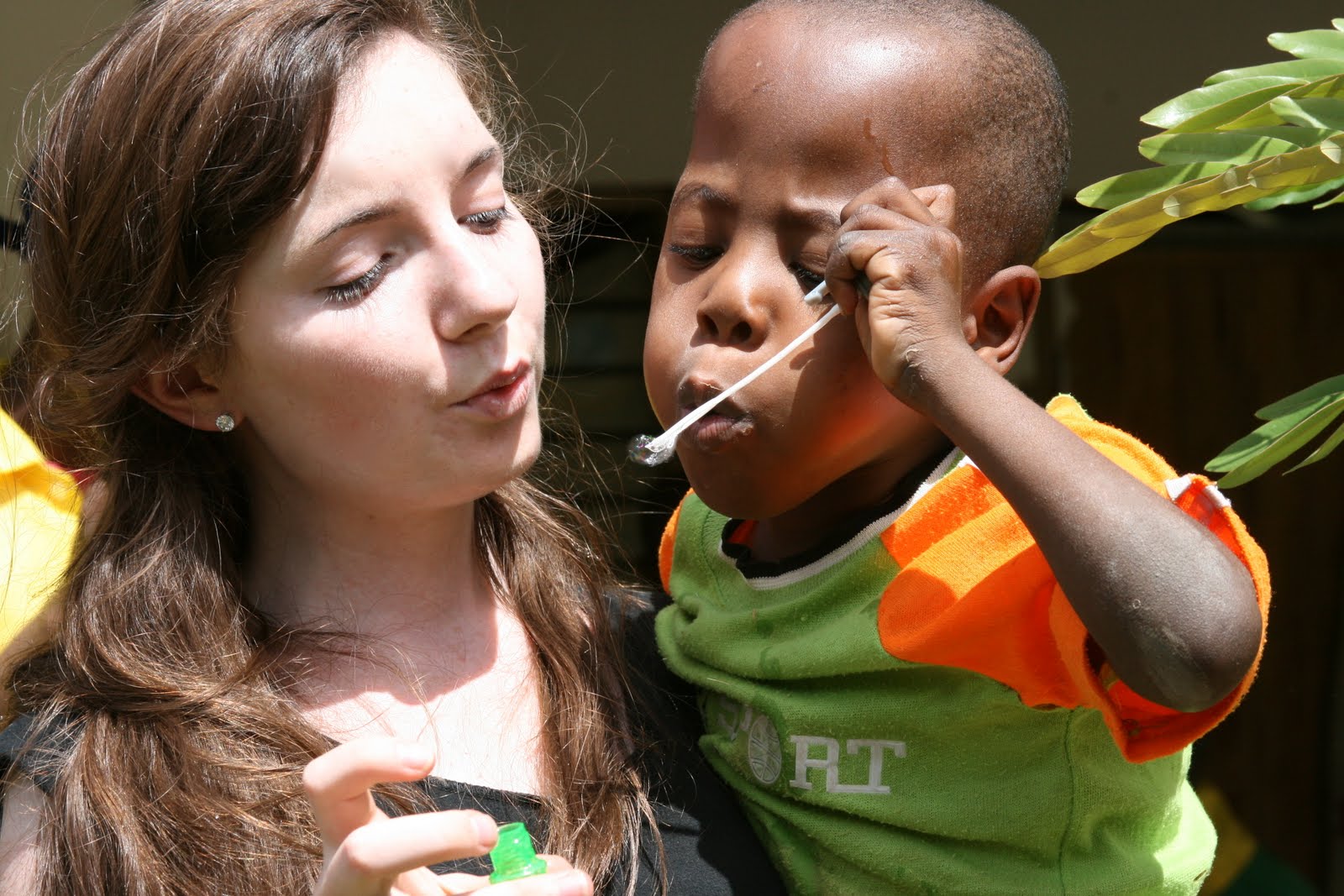
When he holds me close, I want to kiss his cheek.
When he looks up at me, I want to kiss his nose.
I love Beja.
No, Beja is not a boyfriend (who needs one of those?). Beja is one of the students at the school dedicated in memory of my brother in Mynzeni, Kenya: the Sean Michels School for Special Needs.
This past week, my family and I returned from Mynzeni, where we treated over three hundred Kenyans at our makeshift dental clinic.
(For pictures and a write-up of the trip, check out seanmichelsschool.blogspot.com
At Seany’s school, we have twenty-three beautiful, gorgeous, kind, grateful students (enough synonyms for you?).
This trip, I was in charge of taking pictures with my new handy-dandy camera.
It is a Sony.
With a microphone.
And I absolutely adore my new bit of technology.
As soon as I saw our children smile, my camera shutter went off. The flash bloomed a thousand times. The children thought my eye turned into a black, technical protrusion.
I love to take pictures of these special, beautiful children. They each walk so confidently. They do not hide their amputated arms or deformed feet. They smile for the picture.
But as I go through the pictures now, I must admit: most of my pictures are of Beja.
I know it is wrong to play favorites.
And I promise I do not have favorites.
I just love to hold Beja until my arms ache.
One day during the trip, Baba Bret came up while I was holding Beja. Beja had just gotten a cavity fixed. And I was feeling like a villain for holding Beja down while the dentist jabbed mosquito-like needles into his cheek.
"I’m sorry Beja," I said, murmuring apologies into his ear.
Beja tucked his head under my chin and looked up with puppy dog, hazelnut eyes. He jutted out his lip and motioned to the trash. He needed to spit again. I rushed him over to the trash bin and he sputtered up more spit and blood.
After wiping up his brown, puckered lip, I continued to walk around the Koins site.. Beja looked up and saw Baba Bret nearby. Baba Bret called out Beja's name and took him into his own arms.
My arms felt empty.
I can be quite possessive over Beja so I waited for Baba Bret to be done playing with Beja.
Bret showed Beja his camera and tickled him until he smiled, his brazen, devilish smile.
Then Bret looked at me.
"Beja, is this your other mama? Your white mama?" Bret said, playfully.
I just smiled sheepishly, hoping he would say yes. I want Beja to love me so bad, it hurts.
Beja just grinned wider. Then, he shifted away from Bret, towards me.
"He is leaning to you," Bret said, kindly.
I reached out and took Beja into my arms. I tucked his crumpled legs around my waist. And I walked around the Koins site, pretending to be an African mama. Regal. Strong. With a child wrapped around me like a sarong.
Preamble
In the following code of ethics, I promise to never lose my morals to ambition. While the script of life cannot be scripted out beforehand, I promise that wherever I tote around my reporter’s notebook, I will take these values with me.
1. Be Truthful
a. When I report on stories, I will pursue the truth and take no shortcuts to a story. Indeed, I will do the work necessary to uncover all the information in order to best inform my audience. Even if I am under pressure and am rushed to meet deadline, I will never fabricate or plagiarize. Furthermore, I will recognize the difference between reporting what is accurate and what is true. While a quote may be accurate, it may not be true. I pledge to do my best to publish the truth. I understand that if I abandon this principle, I will be hurting all those who read my words.
i. “Verily, verily, I say unto you, wo be unto him that lieth to deceive because he supposeth that another lieth to deceive, for such are not exempt from the justice of God” (D&C 10:28).
ii. “How rare a gem, how precious a jewel is the man or woman in whom there is neither guile nor deception nor falsehood!” (President Gordon B. Hinckley, We Believe in Being Honest).
2. Defend the Right to Write
a. People often vehemently defend their own way of thinking. They see in their selective opinions on controversial topics an embodiment of who they are as a person. In my writing as a journalist, I will defend the right of writers to express their opinions in editorial pieces. Likewise, I will respect readers’ responses to articles. Indeed, I will defend a person’s right to express opinions that I disagree with. We cannot smother another’s opinions and force them to dress in our own beliefs. Rather, we must allow writers to write that which they believe.
i. “Monsieur l'abbĂ©, I detest what you write, but I would give my life to make it possible for you to continue to write'' (Voltaire, Schindler.org).
3. Assert My Independence
a. When I write a story, I will not be sold by bribes. No promise of money or promotion will keep me from publishing the truth. Neither will I espouse myself to political organizations, which could caste doubt on my ability to report fairly.
i. “Remain free of associations and activities that may compromise integrity or damage credibility” (SPJ Code of Ethics).
ii. “Personal integrity implies such trustworthiness and incorruptibility that we are incapable of being false to a trust or covenant” (Elder Joseph B. Wirthlin, Personal Integrity).
4. Accept Responsibility for My Actions
a. When something goes awry in a newsroom, I know the tendency can be to point fingers. However, I will accept responsibility for my actions. If I make a mistake, I will admit it and do whatever possible to fix that mistake. Furthermore, I will apologize to my readers, explain the reasons behind my mistake, and make a plan for it to never happen again. I want my readers to be able to trust me and I understand that for this to happen, I need to admit my shortcomings to them.
i. “Admit mistakes and correct them promptly” (SPJ Code of Ethics).
ii. “But I am like a green olive tree in the house of God: I trust in the mercy of God for ever and ever” (Psalms 51:8).
5. Consider All Sides
a. Growing up with sisters, I know that there can be multiple perspectives on how a disagreement or conflict originates. Knowing this, I will make sure to listen to a range of voices from those involved in each of the stories I cover. I will never use one source but will dedicate myself to pursuing quotes from multiple sources. I will not let my particular opinions tempt me into using just the quotes that suit my particular opinions.
i. “Support the open exchange of views, even views they find repugnant” (SPJ Code of Ethics).
6. Be a Responsible Watchdog
a. As a journalist, I will try and protect citizens by monitoring the actions of government, business, and other figureheads. I will not allow the mighty few to take advantage of the public. I realize that to uncover corruption, investigative reporting is necessary. When acting as an investigative journalist, I will be careful about using anonymous sources, making sure to validate their claims. In my pursuit of the truth, I plan to look into stories that concern and affect the lives of citizens. Indeed, I want to do more than investigate what a particular celebrity ate for lunch.
i. “Always question sources’ motives before promising anonymity. Clarify conditions attached to any promise made in exchange for information. Keep promises” (SPJ Code of Ethics).
7. Demonstrate Compassion
a. The other day, I was reading the paper in my weight training class. My coach was looking at the paper with me. When he finished reading he said, “I am now smarter,” and after a pause, “and more upset.” Our world is not a perfect place. Consequentially, I understand that the news is often bleak and troubling. Indeed, the news is often an interviewee’s personal tragedy. As a journalist, I will demonstrate compassion to those who are the subjects of tragedies. I will not demand quotes from those who wish to suffer silently. Nor will I mistreat those who do confide their tragic stories to me.
i. “Ethical journalists treat sources, subjects and colleagues as human beings deserving of respect” (SPJ Code of Ethics).
ii. “Be kind, for everyone you meet is fighting a hard battle” (Plato, Quotationspage.com).
iii. “Let us all recognize that each of us is a son or daughter of our Father in Heaven, who loves all of His children” (President Gordon B. Hinckley, The Need for Greater Kindness).
8. Be an Advocate for the Suffering
a. I am afraid to leave the world without first doing something to make it a better place. As a journalist, I wish to point out those who are alone, lost, abused and demand that they be noticed. Did those in ancient Jerusalem know about the leprosy colonies? Did an ancient newspaper right about the leper’s condition? As a modern-day journalist, I will point out the metaphorical leper colonies. I simply want to be my brother’s keeper. Unlike Cain of the Bible, I will know where my brother is and I will tell the world about his needs.
i. “The Lord said unto Cain, Where is Abel thy brother? And he said, I know not: Am I my brother’s keeper?” (Genesis 4:9).
ii. “God bless all who endeavor to be their brother’s keeper, who give to ameliorate suffering, who strive with all that is good within them to make a better world. Have you noticed that such individuals have a brighter smile?” (President Thomas S. Monson, Our Brothers’ Keepers).
Okay, so that wasn’t the response I was hoping for, I thought glumly. The cold Connecticut winter drew frosty breaths from my frequent sighs as I walked into the high school alone. I dug my hands further into my pockets and told myself that it was time to face the facts.
At some point, every journalist must face the facts.
The facts: In my senior year, I was co-editor-in-chief of my high school newspaper. I was also and am still a member of the Church of Jesus Christ of Latter-day Saints. In other words, I am a Mormon. When I became an editor, I knew that some of my classmates and teachers would look at my articles and editorials with skepticism because of my faith. However, I promised myself that I would always strive for balance in my articles. But then a problem arose.
The problem: After the suggestion came from my advisor and another student, my high school paper decided to run a story on the Mormon seminary I attended close by my school. I had no intention of writing the article, knowing it would be seen as Mormon propaganda. Instead, I assigned the story to one of the student reporters, went with her to seminary, and encouraged her to interview the people there. Of course, I was not interviewed for objectivity’s sake.
I silently gave myself a pat on the back for being so objective, but then the reporter’s article showed up on my desk.
The article began: “A student wakes up at 5:30am and scrambles to get ready. She dresses herself in a black robe and bonnet and fixes her hair around her horns. She says goodbye to her father and his wife…and then his other wife, and she is off to a morning of rituals and prayer…just kidding!...These are all common misconceptions about the Mormon religion.”
My reaction as an editor: Great introduction. This will really hook the readers.
My reaction as a Mormon seminary student: Oh no. What is everyone in my seminary class going to think about this?
The answer to the last question is that they were not happy. I walked into my high school alone after they heard the introduction.
Yes, as an editor I printed the introduction. Why? Because the title of the story was “Pancakes and Prayer: My Experience at a Mormon Seminary.” Indeed, it was the reporter’s experience at seminary. It was not called “Pancakes and Prayer: What a Reporter Got from Going to a Mormon Seminary According to Her Mormon Editor.” One, the latter title is much too long and I don’t think readers would appreciate the obvious bias.
More importantly, the entire article accurately conveyed the reporter’s experience at seminary. What she wrote was true and well written. I couldn’t let my fears draw red lines through her work. Eventually, my fellow seminary classmates realized this too. Especially when non-member students mentioned how much they enjoyed the article.
One of the questions for today’s blog assignment was “Can you be a person of faith and still (objectively) fairly report about religious issues?” Well, I sure hope so! If not, then I’m afraid there would either be no religion beat or no fair reporting. Every religion reporter is “a person of faith,” whether they have faith in a Christian God, a Jewish God, or no god at all.
In our assigned reading from Jim Willis’s The Mind of a Journalist, the On Faith Web site producer David Waters says, “Religion is the most important topic out there. It matters to nearly everyone, even to atheists and agnostics” (87).
Likewise, in an article on PoynterOnline, Diane Connolly discusses her experience as religion editor at The Dallas Morning News. Ms. Connolly says that one of the qualities she looked for in religion reporters was a, “Recognition that religion is a potent force that unites and divides people in powerful ways that affect everything from military conflicts to government policy to everyday actions in ordinary people's lives.”
Both Mr. Willis and Ms. Connolly recognize that religion is not just a prayer on Sunday. Religion is the reason for many headlines. Indeed, faith leads to action and action leads to the news.
Indeed, religion is in the news in simple divorce stories and in complex war stories. Religion was even mentioned on the front page of today's issue of The New York Times with another version online.
Even for me, a student reporter in high school, religion was a topic of interest. Near the end of my senior year, another problem arose relating to religion.
Another problem: I wanted to write a profile on a teacher in my school who is a member of the Family Federation for World Peace. Members of this federation are often called “Moonies." When I interviewed the teacher, I excitedly scribbled down his thoughts regarding his arranged marriage and beliefs in Jesus Christ. However, throughout the interview, the teacher attempted to relate his religion back to my own. While he was trying to help my understanding, I had to remember that as a reporter my faith is not a part of the story I’m covering. I respectfully listened to what he had to say, but, throughout the interview I reminded myself that I was a reporter.
When I picked up my pen, I edited my own beliefs out.